

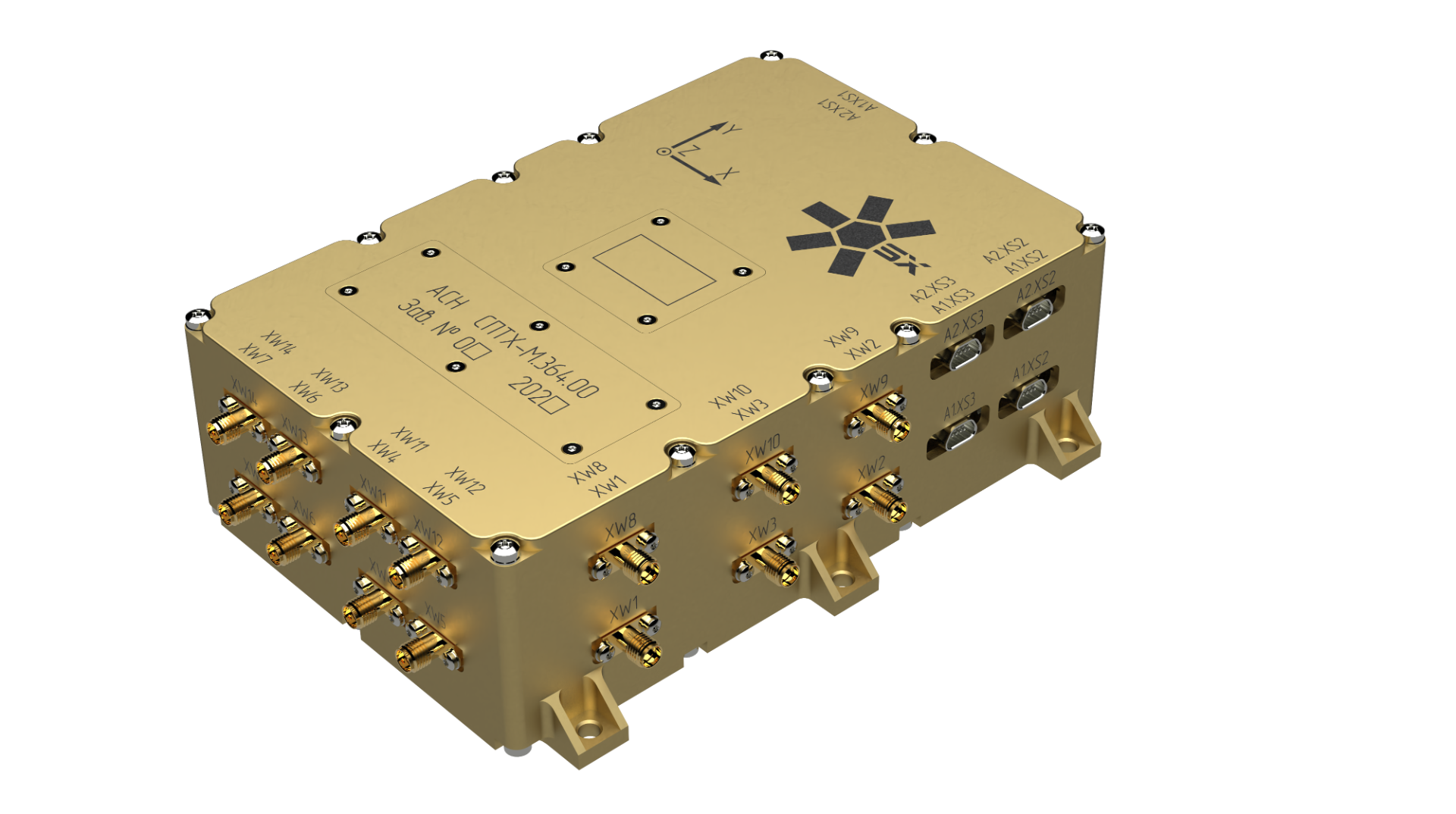
The task of the device is to adjust the output signal of 1 Hz bearing to the signal of 1 Hz of the navigation receiver in time so that the averaged position of the signal of 1 Hz CNE coincides with 1 Hz bearing, and to keep the signal of 1 Hz bearing in its current position in the absence of signal 1 Hz navigation receiver.
The device uses a highly stable (high short-term stability) crystal oscillator with a typical frequency of 10 MHz as its own source of time and frequency. The adjustment depending on the change in the control voltage is ± 3 · 10-7, which is approximately 3 Hz. This change in frequency to the extreme positions relative to real 10 MHz creates a lead or, accordingly, a lag of the signal divided by 107 1 Hz relative to the divided real 10 MHz for a period of 1 s by 300 ns. As real 1 Hz, you can take the averaged position of 1 Hz of the navigation receiver.
Own development of the company according to company standards, compatible with ECSS recommendations, relatively low cost, light weight and energy consumption; adaptation to customer requirements; use of unified electrical, information and mechanical interfaces; at the beginning of 2022, the GEM cycle will take place.
|
Parameters |
|
|
Dimensions, mm |
171 х 111 х 51 (without fasteners) |
|
Mass, kg |
0,7 |
|
Power voltage, V |
22 — 34 , galvanic isolation 500 V |
|
Power consumption, Wt |
2 |
|
Duplicated interfaces |
CAN2B, SpaceWire |
|
Coordinate determination error, m |
10 (sigma) |
|
Speed determination error, m / s |
0,01 |
|
Time error |
±10-8 s during the battery life of at least 48 hours. |
