

SPUTNIX presented a spacecraft with an art object
At the office of the private space company SPUTNIX took place the presentation of the socio-cultural project “Octopus Octo-Pax” by Russian artist Nastya Miro and the university satellite on which the art object will be sent into orbit. The goal of the project is to draw the attention of society and youth audiences to environmental problems and pollution of the near-Earth space. In the company's laboratory, engineers presented a satellite that will be used as part of the Octo-Pax Octopus project.
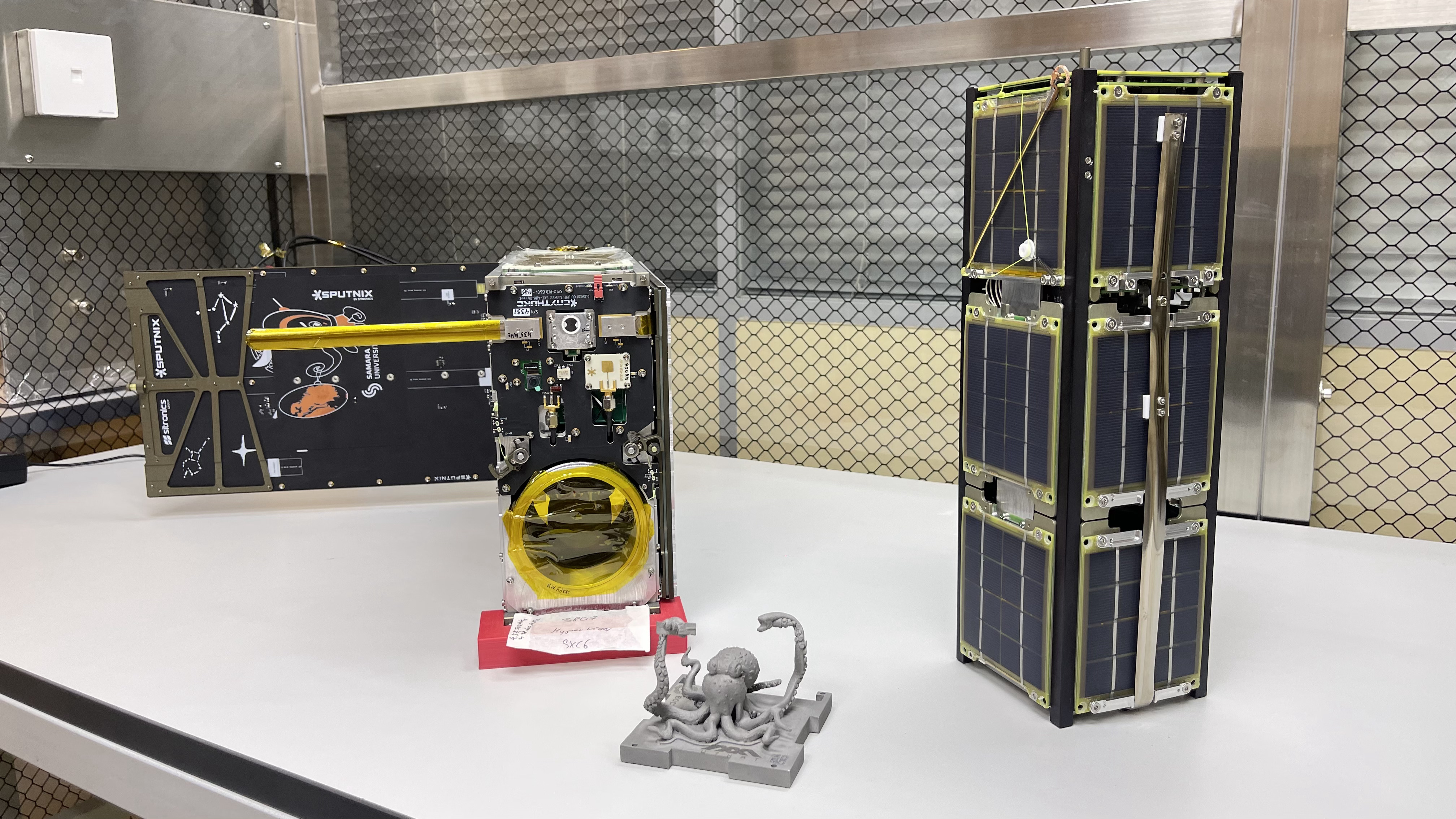
The Arctic-Sat cubesat spacecraft was built for the Northern Arctic Federal University (NArFU) under the Space Pi program and is intended to study the effect of cosmic radiation on the satellite itself, as well as to track the location of sea vessels. To do this, it will house a universal cosmic radiation detector (DeCoR) and a satellite receiver for automatic identification of ships (AIS). Inside, the device will also be equipped with a camera directed at the art object. This will make it possible to remotely monitor the space travel of the octopus. The satellite's launch into orbit is scheduled for 2024.
“The satellite we built will solve several problems at once. Firstly, it will complement the existing group of our satellites for sea vessels tracking. Secondly, it will allow participants in the federal project “On Duty for the Planet”, within the framework of the Space Pi educational program, to obtain scientific data on the effect of cosmic radiation on cubesats. And the third component is cultural and educational. The issue of contamination of near-Earth space becomes more and more relevant every year. Therefore, we willingly supported the idea of this project and became its technological partner. For our part, we continue to participate in the project to test the VERA plasma engine in orbit, one of the functional features of which is the spacecraft deorbiting,” said SPUTNIX General Director Vladislav Ivanenko.
The 3D art object “Octopus Octo-Pax” was presented by its author, Russian artist Nastya Miro. According to her, this image was not chosen by chance: in nature, octopuses guard the ecology and cleanliness of the seabed. By analogy, the Octo-Pax Octopus is a symbol of the need to combat space debris. The figure is made with high precision from the domestic metal powder composition AK9ch on an industrial 3D printer using selective laser melting technology - a special alloy is able to withstand all the loads and negative impacts associated with the launch outside the Earth’s atmosphere.
The scientific and educational project Space Pi which is part of the “On Duty for the Planet” program, organized with the support of the FASIE, allows schoolchildren and students to learn everything about satellite construction, payloads, learn how to program spacecraft and work with space data. When implementing their ideas, schoolchildren receive professional support from university teachers, designers, programmers - all those who build satellite platforms, payloads and ground receiving stations.